
Feedback, compliments and complaints
We welcome feedback, compliments and complaints about our services. Your feedback helps us improve how we work and the services we provide. This page explains how to share your experience, what you can expect from us, and how we will respond.
You may also download the Feedback, compliments and complaints policy as a pdf.
Introduction
The Independent Review Officer is an independent statutory officeholder established under Schedule 5 of the Personal Injury Commission Act 2020 (PIC Act). The Independent Review Office (IRO) is a government agency that supports the Officer in carrying out their work.
At the IRO, we want to make it easy for everyone to contact us. We are committed to listening carefully when people give feedback, make a complaint, or use our services. Hearing directly from people helps us understand what is working well and where we can improve how we do things. We know the best way to understand how well our services are working is to hear from the people who use them. The feedback, compliments and complaints we receive about our services help us to keep improving. This policy supports being responsible, fair and respectful when we work with others.
Our approach to complaint handling is guided by our values: integrity, trust, service and accountability. We also follow some key principles to ensure that complaints are handled well. These include treating people with respect, making information easy to access, communicating clearly, taking responsibility, responding on time and being open and transparent.
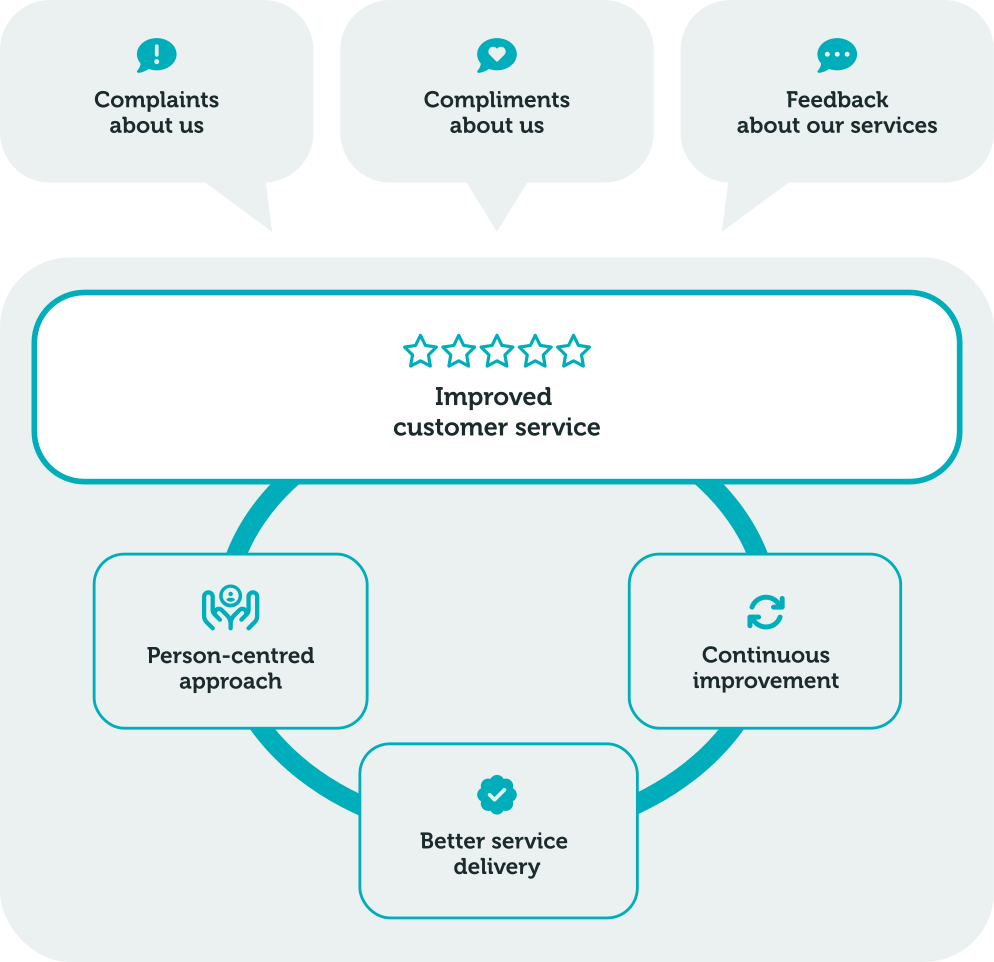
As shown below in Figure 1, what we learn helps us improve how we work and deliver our services. It also helps us focus more on people when handling complaints and provides a better experience for everyone who uses our services.
The difference between feedback and a complaint is that:
- feedback can be positive, negative or neutral, whereas a complaint always involves an expression of dissatisfaction,
- with a complaint, a response to that dissatisfaction is required or expected.
Compliment has its ordinary meaning, being an expression of praise, commendation or admiration.
You can lodge a complaint about us if you think our behaviour or customer service did not meet a reasonable standard. For example, this could include being unhappy with:
- how we handled your complaint,
- a decision we made, or
- how a staff member behaved towards you.
This policy explains how we receive and respond to compliments, feedback and complaints from people who are injured and those who represent them.
How to give us feedback, compliment us or make a complaint
You can make a complaint, give feedback or share a compliment in several easy ways:
- at any time using our online form, or
- by calling us on 139 476 if you need help to complete the online form.
Information about when our staff are available to take calls is on our contact page. Phone support is available Monday to Friday (excluding public holidays).
We take anonymous complaints just as seriously as any other complaint. However, if you do not give us your name or contact details, we will not be able to update you on the progress or outcome.
Respectful Treatment
Our staff are trained to be helpful, polite and respectful. We expect the same respect when people use our services. This means speaking calmly, without yelling, making threats or using abusive language, and not recording our staff without their permission.
Information and Accessibility
You should let us know if you need an interpreter or translator, especially if English is not your first language.
We also use the National Relay Service. This is a phone service that helps people who are deaf, hard of hearing or have difficulty with speech to contact us in a way to suit their needs and preferences.
When contacting us, you are responsible for giving us as much relevant information as you can. Please also tell us if you need any reasonable adjustments so we can support you.
When making a complaint about our service, please explain what you expected from us. Tell us what your service expectations were. For example, your complaint may be about:
- a decision we made about how to handle your complaint, including a decision to close your complaint
- the behaviour of an IRO staff member when engaging with you
- how long we took to respond to your complaint, or to take action on the issues you raised
- information we provided (for example, if the information we gave you was incorrect)
- whether we did what we said we would do.
Please also explain how we did not meet your expectations.
We will review the information you give us in your complaint and decide what action to take.
What we will do
We will communicate clearly with you throughout the process. Our way of receiving and responding to complaints follows a number of steps.
The steps we take are shown here:
Step 1
Acknowledge & Navigate
- Acknowledge that we have received your Complaint within two (2) working days
- Explain the process
- Refer your Compliant to the right support
Step 2
Assess and Inform
-
Introduce ourselves and keep you informed
-
Ask questions and gather information
-
Work with you to resolve your Complaint
Step 3
Resolve and Close
-
Aim to resolve your Complaint within 20 working days
-
Inform you of the outcome and close your Complaint
-
Confirm with you alternative pathways if you are not satisfied
Step 4
Inform Continuous Improvement
- We use our data to help us improve our services and to inform the ecosystem for improved scheme performance
Once we receive your complaint, we will:
- acknowledge your complaint within two (2) working days and tell you what to expect.
- assess and decide the best way to record your complaint and to handle the issue raised. If needed, we may refer the matter to another agency. If we decide to do that, we will let you know.
- if necessary, make enquiries about the information we receive to support a complaint; we might also ask for more information.
- contact you and provide regular updates so that you know what is happening.
- work to resolve the complaint and explain the outcome including any steps we have taken to address the issues raised. We aim to resolve any complaint within 20 working days, but sooner where possible.
- close and review the handling of the complaint to make sure the process was appropriate in the circumstances, and to identify what we could do better next time in providing our services.
- inform continuous improvement by looking at the information that we have collected. This may enable us to identify trends and manage risks, with a view to achieve improved customer experience and service delivery.
Our commitment to you
We take ownership and will ensure that staff who receive and manage feedback, compliments and complaints about us are properly trained and supported to record, assess and resolve concerns raised about us.
We aim to resolve complaints about us immediately, which our frontline staff will do directly with the person who is making the complaint. If a complaint is serious, or complex, we may ask a more experienced officer or another IRO team to assess and resolve it.
You will be assigned a contact person in relation to your complaint. We will let you know if a complaint is transferred to another person or team while it is being handled.
Timeliness and Transparency
We expect to resolve your complaint as quickly as possible. To support timeliness, we have established a timeframe of 20 working days to resolve a complaint about us.
Where more time is required to manage a matter due to its complexity, we will inform you of any unavoidable delays and explain the reasons.
We will record and conduct analysis and evaluation of complaint data including timeliness, categories of issues raised and the actions and improvements taken in response. We analyse trends identified through feedback, compliments and complaints, to ensure we can learn from the insights, strengthen accountability and promote continuous improvement in our services.
Asking for internal review of our decision
Before asking for a review of our decision, you should contact the IRO officer who told you about the decision. This gives you a chance to talk through the reasons for the decision and ask any questions you still have. If you are still unhappy after this discussion, you can ask for an internal review. For more information, please refer to our guidance on How to ask for internal review of our decision.
Complaints about us to the NSW Ombudsman
If you have complained about us and are not satisfied with the outcome after we have handled your complaint or completed an internal review, you can make a complaint to the NSW Ombudsman.
Contact information for the NSW Ombudsman
Telephone: 1800 451 524 (Monday to Friday between 9am to 4pm)
Website: www.ombo.nsw.gov.au
Foundational principles for effective complaints management
This policy has been developed having regard to the NSW Ombudsman's Effective Complaint Management Guidelines (November 2024) (pdf) and the Australian Standard Guidelines for complaint management in organizations (AS 10002:2022). This policy is also informed by the NSW Ombudsman's report titled NSW public sector complaint handling in 2025, which was tabled in the NSW Parliament on 9 March 2026.
We adopt the following foundational principles for effective complaint management: Respectful Treatment, Information and Accessibility, Communication, Taking Ownership, Timeliness and Transparency.
Dictionary
| Term | Meaning |
|---|---|
| Complaint | A concern raised to or about the IRO, the quality of its procedures, services or decisions, or the conduct of staff members. A complaint always involves an expression of dissatisfaction, to which a response is required or expected. |
| Compliment | This word has its ordinary meaning, being an expression of praise, commendation or admiration. |
| Feedback | This word has its ordinary meaning, which can be positive, negative or neutral. |
| Independent Review Officer (Officer) | A statutory officer appointed by the Governor of NSW under Schedule 5, Part 2 of the Personal Injury Commission Act 2020 and is the head of the Office of the Independent Review Officer. |
The definitions are adapted from the NSW Ombudsman's Effective Complaint Management Guidelines (pdf) (November 2024)